
The role of ankle in every action of the game
Updated: 2 days ago
By Pablo Dip - Método PD
Everything starts from the ground. And what connects you to the ground is your foot and ankle.
In football we talk a lot about power, speed and explosive strength. And rightly so, because that's what wins matches. But few people look at the first link in the chain: the ankle-foot complex, the only point of contact between your body and the ground. Every sprint, every deceleration, every change of direction and every jump starts there. If that base fails, everything you build on top of it fails with it.
What the ankle does in every action of the game
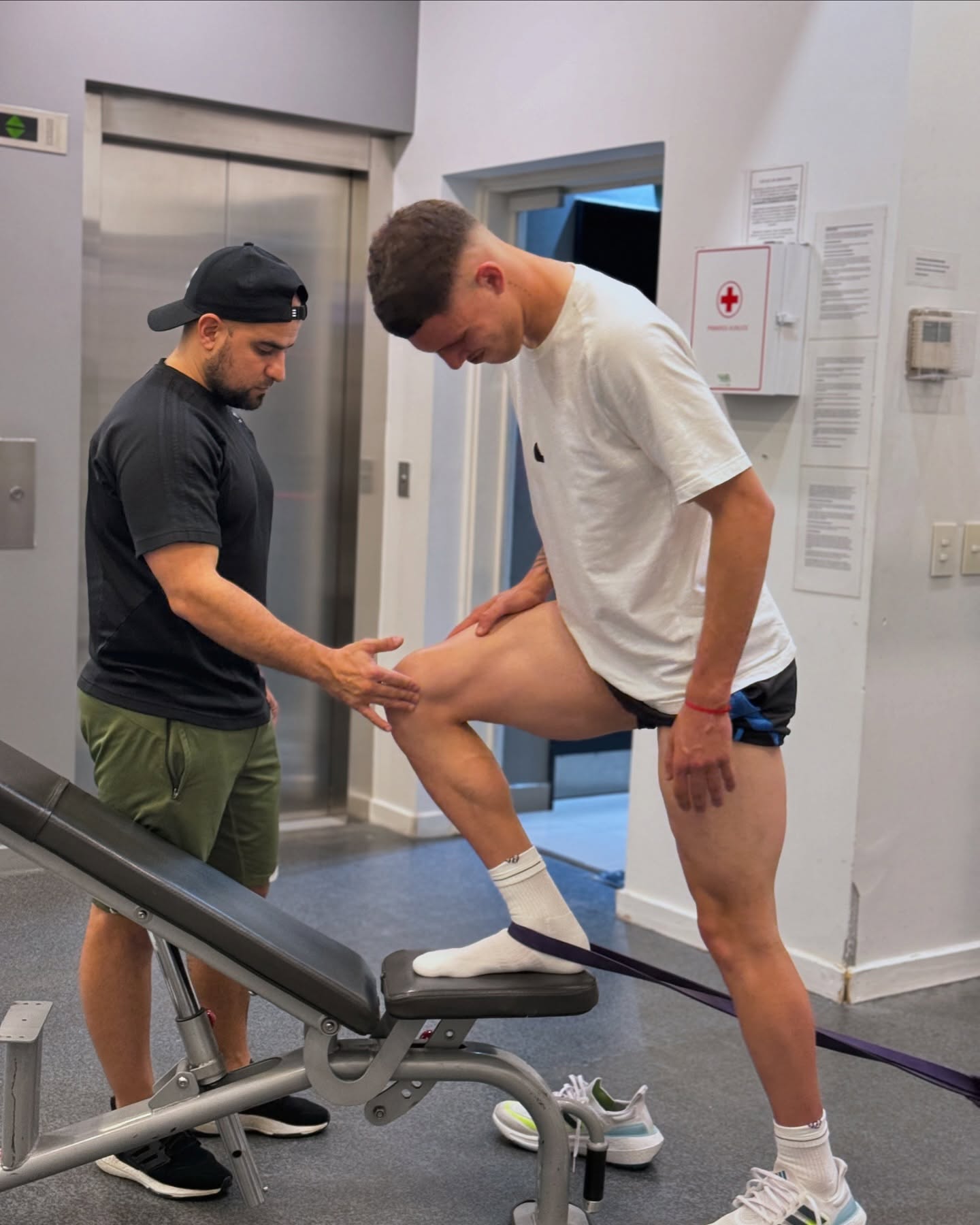
The quality that matters most is dorsiflexion: the ability of the knee to move forward past the toes while keeping the heel on the ground.
It's the movement you make when you brake, when you absorb a landing or when you squat down.
When that dorsiflexion is good, the ankle absorbs force and returns it; it can cushion a significant part of the energy of every landing. When it's poor, that energy doesn't disappear: it travels up the chain and is is transferred to other structures that aren't designed to handle it (Fong et al., 2011).
The evidence in footballers is clear:
Worse landing control. The lower the dorsiflexion, the more landing errors ocurr football-specific tasks. Ankle mobility can explain around 20% of landing quality: a lot for a single variable.
Better performance with more mobility. A greater range of motion is associated with better vertical jump performance and better jump tests results, because it reduces ground contact time and improves force production.
Football tends to take mobility away from you. Footballers often show less dorsiflexion than the general population, and that range drops over the course of the season. If you don't train it, you lose it.
The foot: the other half of the base
Talking only about the ankle means stopping halfway. The ankle doesn't work alone: it works together with the foot, and the foot is much more than a passive platform.
Research now describes the "foot core system" (McKeon et al., 2015): just as your core stabilizes your trunk, the foot has its own stability core. It consists of three components that work together: the passive one (bones, plantar fascia and ligaments that form the arch), the active one (the intrinsic musculature of the foot) and the neural one (sensory information from the sole). The receptors in the sole and those muscles are the main source of information for detecting changes in posture, and they allow the foot to react quickly to stabilize the ankle and maintain balance.
In plain terms: a strong, "awake" foot supports the arch, controls pronation and gives the ankle a stable base to move from. A sleepy or weak foot leaves the ankle working alone, and that's where problems begin. That's why, when I talk about stability, I talk about ankle-foot stability as a unit, not the ankle in isolation.
The link almost no one makes: the ankle-foot and the knee
Here's the important part: that this isn't only about performance, but also about prevention.
When the ankle lacks dorsiflexion, the body looks for that movement somewhere else. The foot overpronates, the tibia rotates inward, the knee caves inward and dynamic knee valgus appears: that knee that collapses toward the center on landing or braking. This pattern is one of the mechanisms most associated with knee injuries, including the anterior cruciate ligament (Lima et al., 2018).
The chain is one single unit: if one joint loses mobility, the one next to it pays the price. A stiff or unstable ankle-foot isn't a local problem: it's a knee problem waiting to happen.
The good news is that it works the other way too. Ankle mobility programs of just a few weeks improved range and reduced knee valgus angles by between 20% and 50% on landing and cutting. Working on the base changes what happens higher up.
And the chain does not end at the knee. The hip is the other end of the problem, and I covered it in this article.
How it fits into the way I work
This is a good example of my method in general: goals are built in order, like a pyramid. First I secure the base: Mobility and good ankle-foot stability and only on top of that do I load control, strength and power applied to the sporting movement. Adding strength on top of a stiff or unstable ankle-foot means accelerating toward injury. The order isn't a detail: it's what makes the work last.
Mini test: how is your dorsiflexion?
You can do a rough test at home, known as the knee-to-wall test:
Stand facing a wall, barefoot.
Place the tip of your foot about 10 cm from the wall (measure it).
Without lifting your heel off the ground, drive your knee forward trying to touch the wall. Does the knee touch without the heel lifting? Good sign. Doesn't it reach, or does the heel lifts? You probably have limited dorsiflexion on that side. Repeat with the other foot and compare: a marked difference between sides is as important as the lack of range itself.
An extra for the foot: standing and barefoot, try to "shorten" the foot by drawing the base of your toes toward the heel without curling your toes, lifting the arch. If you struggle to hold it or don't know how to activate it, your foot core needs more work.
These tests don't replace a professional assessment, but they give you a first clue. If you can't reach, or if one side is much worse than the other, that's the signal to work on the base before adding more load.
Conclusion
The ankle and the foot aren't the glamorous part of training, but they're where everything starts. Good ankle mobility and a stable ankle-foot base improve your landing, your jump and your change of direction, and protect your knees from the compensations that can lead to injury.
Build from the ground up. It's the only way for what's on top to hold.
Want to know how your base is doing and build on it properly? Write to me and we'll set up your initial assessment.

Comments