
Returning to play is not returning to performance
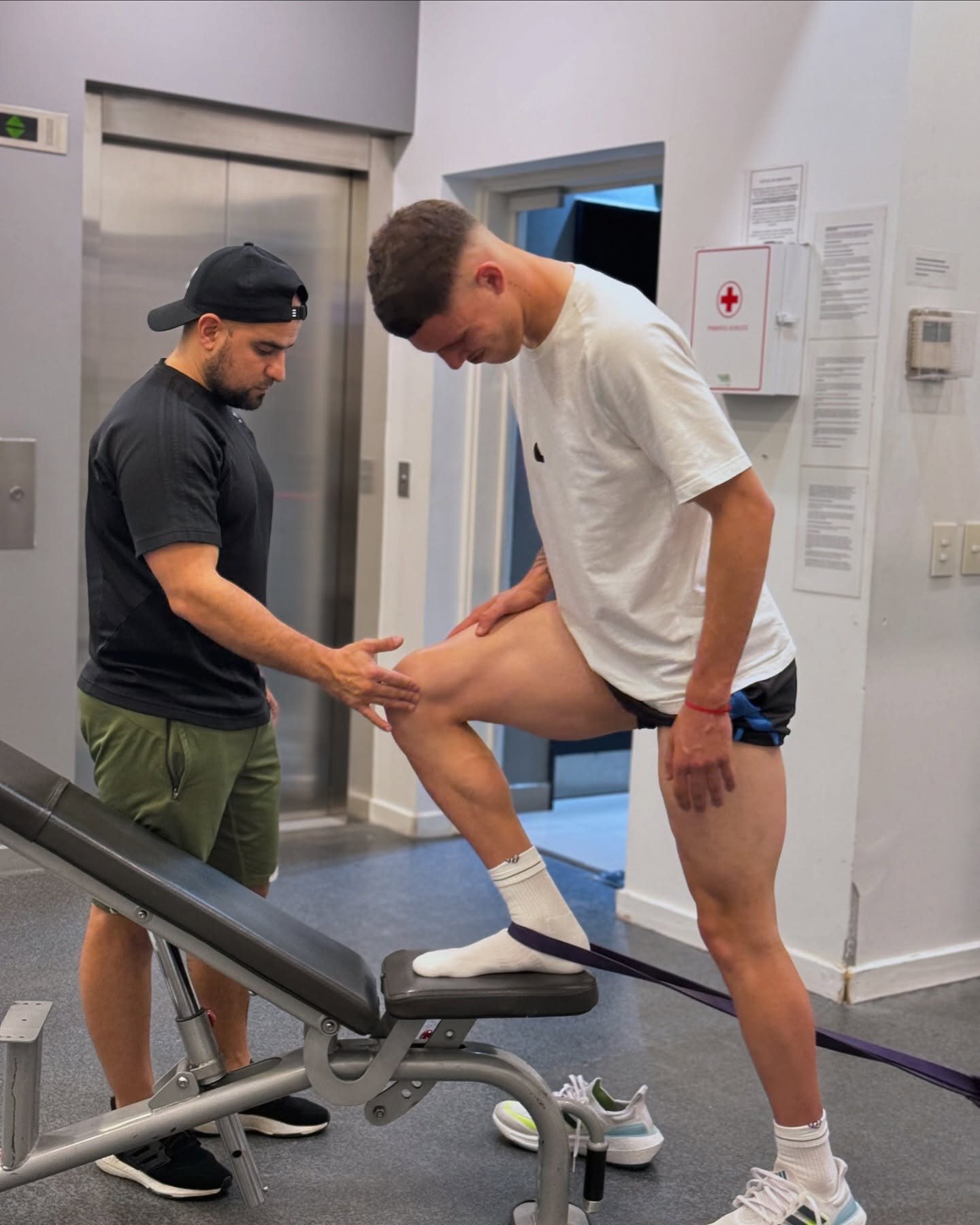
By Pablo Dip - PD Method
The question I get asked most after a serious injury is always the same: when can I play again? And it's a question that is badly framed, however natural it is.
It's badly framed because "playing again" isn't a moment. It's a process with stages, each with its own criteria for moving on and each with a different person responsible. And because the answer it's looking for is a date, when the date is the least informative thing of all.
This article is about that: about how the process is organised, what the evidence says about timelines, and where each person's role begins and ends. Mine included.
In short: the calendar clears nobody. Criteria do, and every stage of the process has a different person responsible for it.
Three stages, not one
The leading international consensus on return to sport after anterior cruciate ligament injury, produced by a multidisciplinary group of experts, defines the process as a continuum of three stages: return to participation, return to sport and return to performance.
Translated: going back to training with the group isn't playing again. Playing again isn't performing the way you did before. They are three different things and each one arrives at a different moment.
That same consensus says something worth underlining, because it runs against everyone's intuition: purely time-based decision-making should be abandoned. The calendar is not a criterion.
What the numbers say about time
The study by Grindem and colleagues, within the Delaware-Oslo cohort, followed patients operated on for an anterior cruciate ligament injury who played pivoting sports over two years. It found three things. First: returning to those sports multiplied the reinjury rate more than fourfold. Second: the reinjury rate fell by 51% for every month that return was delayed up to nine months after surgery, after which no further risk reduction was observed. Third, and most important: 38.2% of those who failed the discharge criteria were reinjured, compared with 5.6% of those who passed them.
In parallel, the work of Kyritsis and colleagues at Aspetar followed 158 professional footballers who had been operated on. Those who returned without meeting the six discharge criteria had four times the risk of rupturing the graft. On top of that, a deficit in the hamstring to quadriceps ratio was associated with a greater risk of rupture.
And the nuance that puts it all in order: later research suggests that, in athletes who completed their rehabilitation and passed all the discharge tests, returning before or after the nine-month mark did not change the risk of a new injury.
So what governs the decision? Criteria govern over the calendar. Time matters because tissue needs time to heal, but reaching nine months without passing the tests protects nobody. And passing the tests without having given the graft time doesn't either.
The problem with mistaking a number for a criterion
There's something here I see often and that's worth explaining properly, because it's the difference between assessing and appearing to assess.
A review that analysed 209 studies on return-to-sport criteria found that time and impairment-based measures dominated those criteria, despite sport being a complex physical and biopsychosocial activity. Put another way: what gets measured is what's easy to measure, not what determines performance on the pitch.
The clearest example is hop testing. A systematic review led by Kotsifaki, also at Aspetar, concluded that measuring only hop distance, even using the healthy leg as a reference, is insufficient to assess knee function after a reconstruction. And it found something still more uncomfortable: achieving more than 90% symmetry in distance usually comes with compensatory movements at the hip, the ankle or the knee itself.
In other words: a player can pass the test and still be moving badly. The number says he's symmetrical. The body is solving the hop some other way.
The same goes for strength measured on a machine. Moving a given load on a leg press is useful information, but it's one part of a criterion, not the criterion. Kyritsis's six criteria, for instance, aren't six strength measurements: they include a single hop, a triple hop, a crossover hop and a running test. And even that doesn't settle the question.
What the machine can't measure
This, for me, is the central point.
It has been proposed that anterior cruciate ligament injury is also a neurophysiological injury, with neurocognitive deficits that persist after reconstruction. And recent research supports it: when cognitive demands are added to hop tests, the difference between legs increases under higher cognitive load. Another study from the same year concludes that neurocognitive reliance persists after surgery and that more dual-task challenges are needed in training.
Translated to the pitch: a player can be perfect jumping when he knows he's about to jump, and fall apart when the jump comes without warning, with an opponent on him and a ball to deal with.
And football is exactly that. Running, braking, jumping, landing, reacting to a stimulus you don't control and handling an external object the whole time. A gym with the latest machines reproduces none of that, however good the machines are.
The person who had surgery is a person first and an athlete second. In the early phase, working with machines and equipment is correct and necessary: strength has to be rebuilt in a leg that lost a lot, and it has to be done in a controlled way. But after that, control of your own body has to be rebuilt with stimuli that resemble the game. If that bridge isn't built, the player returns to the pitch with a strong leg and a system that doesn't yet know how to use it under chaos.
The three questions, and who answers each one
Before anyone goes back to competing there are three separate questions on the table.
Has the tissue healed? This is answered by the doctor. It's a clinical and biological question, and nobody else answers it. Not the strength and conditioning coach, not the head coach, not the player.
Does he have the physical capacity and the control to withstand the demands of his sport? This is where the physiotherapist and I come in, each in our own part, and the line between us depends on the team and on the stage of the process.
Is he ready in his head? This is the one most often ignored, and it's measurable. The ACL-RSI scale, developed by Webster and Feller, assesses psychological readiness across three dimensions: emotions, confidence and risk appraisal. Among those who don't return to their previous level, fear of reinjury is the most cited reason. It isn't a soft detail: it's a predictor.
As for who makes the final decision, the shared decision-making model used in elite sport today divides the roles fairly clearly. The healthcare professional is the one who evaluates health status and provides objective information on risks and options. The coach evaluates the player's current ability to perform to a given standard, based on what they know of him, the training he missed and his functional progression. And the player, together with the coach, decides.
My part
I'll say it plainly: I don't diagnose and I don't decide medical clearance. When pain appears, I refer on. When there's surgery involved, clearance is signed by whoever is entitled to sign it.
What I do do, and it's plenty:
Rebuild strength in the operated leg and maintain the one that wasn't operated on, because after surgery like that a great deal is lost throughout that leg and in every one of its aspects.
Work on control of the body: landing, jumping and absorbing the landing, first on two legs and then on one.
Restore the lumbopelvic region, including the pelvic floor. It's the part that gets neglected most, and it conditions both the hip and the prevention of groin pain.
Build stability from the ground up. The soleus, for example, is key to the stability of the ankle-foot complex, and that base conditions everything happening above it. I covered it in the article on ankle and foot mobility.
And above all, prepare the transition to the pitch. In elite football literature this has a name and a structure. Buckthorpe proposes four pillars for on-field rehabilitation: restoring movement quality, physical conditioning, sport-specific skills and the progressive development of chronic training load. And Taberner developed what's known as the control-chaos continuum, today the most widely used framework in professional football for that phase: a progression that runs from high control to high chaos, underpinned by sport-specific conditioning and by the idea of returning the player to the running loads he had before getting injured.
That's my zone. Not before and not after.
A case
Here's one, without names, because it has both faces.
A player I worked with injured his anterior cruciate ligament and nobody knew how badly. He went back to his club and kept training with discomfort. He did a month of strengthening work, not with me, and kept training in pain until, after a match, he couldn't take it any more. Only then did they give him an MRI: the ligament was hanging by a thread and could snap at any moment. He was operated on in Barcelona, by one of Europe's leading surgeons.
First lesson, and the most important in this whole article: he trained for a month on a structure that was about to give way, because the pain was read as discomfort and never investigated. Training through pain that nobody has looked into is the fastest way to turn a problem into surgery.
I started working with him a month after the operation, in the phase of re-educating strength in the operated leg and maintaining the other. We worked alongside the clinic's head physiotherapist, each in our own area, talking often. And it was working: the player was recovering strength and mobility gradually, with judgement and without skipping steps.
Then the context changed. He was on loan, the club where he was playing had other injured players of its own to attend to first, and the club that owned his registration decided to cut the loan short and take him back so he could finish his recovery there. They asked the head physiotherapist and me for a report on everything the player had been doing.
The day they started working with him, they began practically from zero.
Second lesson: the biggest cost of that reset wasn't physical, it was psychological. For the player it was a step backwards and a blow to his morale. And we've already seen that confidence and fear aren't decorations: they're predictors of whether someone returns and how.
From there they adopted a protocol whose central criterion was that, until he moved a given load on the leg press, the player wasn't going out onto the pitch. When they finally did take him out, no landing work had been done.
Third lesson, and this is where all the data above connects: a number on a machine is information, not a discharge criterion. And going out to run without having worked on absorbing your own body weight means skipping a stage of the continuum. I'm not criticising anyone in particular, because I don't know what information they had or what pressures they were working under. I'm criticising the criterion.
The player eventually got tired of training through pain and asked them to change the way he was working. We moved to double sessions and focused on what he was missing: landing, jumping and absorbing the landing on one leg, submaximal strength in the lower and upper body, and soleus work to gain stability in the ankle-foot complex.
The other half: holding your ground
Up to here I've described how I avoid stepping into territory that isn't mine. The other half gets said far less often: holding on to what is.
In that same process I had a conversation with a physiotherapist about the importance of one specific exercise: the Copenhagen Adduction, developed by Thorborg. My position was that it didn't only serve the knee. It's one of the best preventive exercises for adductor-related groin pain, what we all know as pubalgia, and at that point we needed to work on the pelvic floor again as well.
With one detail that was what made the proposal appropriate at that stage: the player was in phase 2, so the version was the short-lever one.
That precision is the difference between knowing an exercise and knowing how to dose it. And it's what held the argument up.
The physiotherapist accepted it and trusted me.
That's what should always happen: each person contributes from their own place, with reasoning behind it, and the other listens. It isn't about staying quiet out of deference, or invading someone else's territory out of enthusiasm. It's about knowing exactly what you can defend and why.
If you're in this situation
If you're coming back from a serious injury, or supporting someone who is, these are the questions worth asking your medical team:
What stage of the process am I in, and what do I have to meet to move to the next one?
What specific criteria will be used to clear me, besides time?
Do those criteria include how I move, or only how much I lift?
When does the on-field work start and what has to happen before it?
If any of those questions doesn't have a clear answer, that isn't your problem. It's information you're missing, and you have every right to ask for it.

